

The holy grail for dry, tight, changing skin: blackcurrant seed oil and GLA

In this post
The short answer
If your skin has gone dry, tight and a bit flat this autumn, this is the oil I'd reach for. Blackcurrant seed oil is one of the few natural sources of GLA, a rare omega-6 fatty acid, and it brings two omega-3s along for the ride. It's why it sits at the heart of my Lotus collection.
And because I'd never ask you to trust something I couldn't fully show you, every claim here links to where I found it.

Lotus started as a selfish idea
I made Lotus for me. Pure self-indulgence. I needed it.
I'm 42, and my skin has been quietly changing the rules. Drier. Tighter. A little dull. Nothing I'd been using had stopped working. The CONCHUS products I loved were exactly as good as they'd always been. It was my skin that had moved on.
So I did what I do for every CONCHUS product. I disappeared down the research rabbit hole, ingredient by ingredient, until one stopped me in my tracks: blackcurrant seed oil.
After eight years of CONCHUS, and hundreds of conversations with customers, I know I'm far from the only one. So Lotus is for me, and for you, if your skin is a little drier, a little tighter, a little different from last year, and looking for a bit of je ne sais quoi.

What is blackcurrant seed oil, and what's in it?
Blackcurrant seed oil is pressed from the tiny seeds inside the berry. Unassuming little things. But the fatty acid line-up is anything but.
The biggest part is linoleic acid, an essential fat your skin relies on. Then come three stars:
- GLA (gamma-linolenic acid): a rare omega-6 that turns up in only a handful of plant oils. Blackcurrant oil carries roughly 15-19% (Scottish Crop Research Institute).
- ALA (alpha-linolenic acid): an omega-3, at around 13% in the same research.
- Stearidonic acid: another omega-3, at around 3%.
Here's what got me. The researchers point out that those two omega-3s are missing, or barely there, in evening primrose and borage oils, the better-known GLA oils. Blackcurrant gives you the lot, in one light oil.

Why does dry, tight skin need these fats?
Think of your skin barrier as a bucket. It's the outer layer that holds water in, and it's built from ceramides, cholesterol and fatty acids (Den et al, 2017). A bucket that holds is skin that feels comfortable and bouncy.
Then life happens. As we get older, those barrier fats fall. One study of women's skin found significantly lower levels of all the major lipids with age, ceramides most of all. In winter, levels were dramatically lower than in spring and summer. The researchers linked both to skin that's more prone to barrier problems and dryness, especially in the colder months (Rogers et al, 1996).
Which explains a great deal about my skin in November.
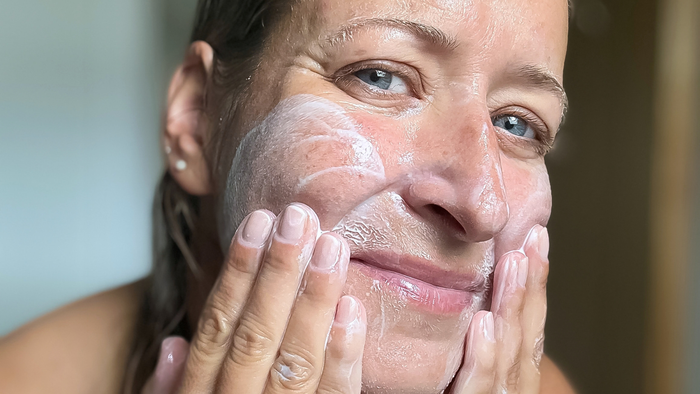
And there's another culprit that rarely gets a mention: your cleanser. Harsh surfactants can damage skin lipids and proteins, which is where that squeaky, tight after-wash feeling comes from, along with dryness and irritation. Everyday cleansing can affect how well the barrier holds water too (cleanser technology review, MDedge, 2017). Researchers even use a detergent called sodium lauryl sulfate to deliberately weaken the barrier when they test barrier-repair products (MDedge).
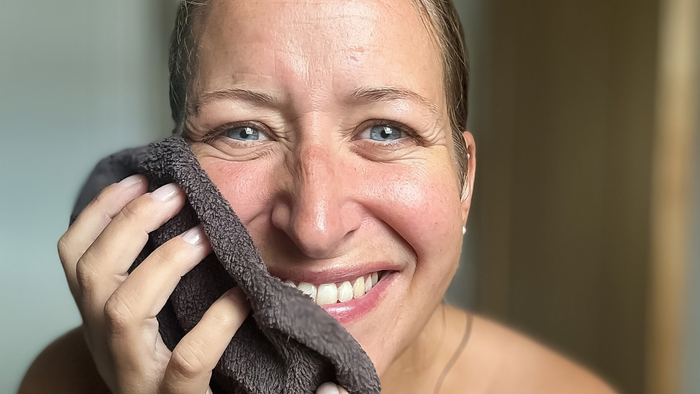
So over-cleansing, or a harsh cleanser, can pull those fats out as fast as you put them back. I believe a cleanse should leave your skin comfortable, not squeaky. To me, that squeak isn't a sign of clean. It's a sign something has been taken away.
Linoleic acid, blackcurrant's biggest fatty acid, is an essential fat, and a shortage of it has been linked to a weaker barrier (Den et al). GLA is described as conditionally essential. Skin's ability to make it for itself appears limited, so there's a case for supplying it (Brosche and Platt, 2000).
I can't tell you exactly what each of these fats does in your skin. I can tell you why I wanted them in the bottles and tins. They're fats your skin's barrier relies on, and my skin was asking for them.

Where does blackcurrant seed oil come from?
Here's my favourite bit. Blackcurrant seeds are a by-product of the juice industry. After the berries are pressed, the seeds are what's left over. This oil gives something that would otherwise be waste a second life (Scottish Crop Research Institute, INKY Ingredients).
Not every blackcurrant seed oil is the same, though. GLA content varies a lot from oil to oil, and it's a detail I care about. So I sourced a blackcurrant seed oil with a stated 15% GLA from INKY Ingredients.
Why freshness matters (and why I make everything in small batches)
GLA-rich oils can go off faster than most, which is why many makers choose refined grades and add vitamin E. It's one more reason I make everything by hand, in small batches, in my Devon studio. Lotus Light Oil, Lotus Light Cream, Lotus Body Balm and Lotus Cleansing Gel all contain vitamin E (tocopherol) too. Freshness is part of the recipe.
Store yours somewhere cool, out of direct sunlight.

Which Lotus products contain blackcurrant seed oil?
Four of them, so you can choose how you'd like to start:
- Lotus Cleansing Gel - the cleanser that melts away make-up, SPF and the day, then rinses clean and never leaves skin tight
- Lotus Light Oil - one multipurpose oil. Use as a face cleanser, make-up remover, hair oil, bath oil, beard oil and all over body oil
- Lotus Light Cream - one instantly hydrating, nutrient dense daily moisturiser for face, hands, body and feet
- Lotus Body Balm - a multipurpose silky balm for cheeks, hands, nails, cuticles, heels, tattoos, beards, and any skin that needs a little more TLC
Every ingredient is listed on every product page, because I'd never ask you to trust something I couldn't fully show you.
One thing to know. The Lotus blend contains clary sage, so Lotus isn't suitable in pregnancy or breastfeeding. Reef Cleansing Gel and Miracle Light Oil are.

Questions people ask
Is blackcurrant seed oil the same as black seed oil?
No, and it catches a lot of people out. Blackcurrant seed oil comes from the blackcurrant berry (Ribes nigrum). Black seed oil comes from Nigella sativa, also called black cumin. Different plants, different oils (INKY Ingredients).
Is blackcurrant seed oil good for eczema?
I can't make medical claims, and no cosmetic can treat eczema, however blackcurrant seed oil can strengthen and support the skin barrier which is often compromised in skin with eczema. If your skin is eczema-prone, talk to your GP or pharmacist, and patch test any new product first.
Can I use Lotus in pregnancy?
No. The Lotus blend contains clary sage. Choose Reef Cleansing Gel or Miracle Light Oil instead.
Which Lotus product should I start with?
If you only try one, I'd start with the Lotus Cleansing Gel. I believe it's worth supporting your barrier before you add anything on top. The Cleansing Gel, Light Cream and Deo Cream have been designed to give you a simple, supportive and beautifully nourishing daily skincare routine.
The one thing to take away
Dry, tight, changing skin isn't something to fight. It's skin telling you what it needs now.
For me, that was an oil I could name, from a seed that would otherwise have been left over, made fresh in small batches in my Devon studio. That's Lotus. The research on these fats and the skin barrier is encouraging rather than conclusive, so I'll never promise you a miracle. I'll just tell you what I chose, and why.
Start gently. Cleanse so your skin feels comfortable, never squeaky. Then add something that supports your skin instead of competing with it.
Be kind to the skin you're in this winter.
Written by Camilla Dyer, founder of CONCHUS. I studied radiotherapy at university, and I've made every CONCHUS product by hand since 2018.
Sources
- Ruiz del Castillo et al, gamma-linolenic acid content of blackcurrant seeds (Scottish Crop Research Institute)
- Rogers et al, 1996, Stratum corneum lipids: the effect of ageing and the seasons
- Den et al, 2017, Skin Barrier Impaired? Two TEWLs to tell
- Brosche and Platt, 2000, borage oil and transepidermal water loss in elderly people
- Cleanser technology review, MDedge, September 2017
- Recommending efficacious cleansers to your patients, MDedge
- INKY Ingredients, blackcurrant seed oil guide, October 2026
Tell me what you think